Public de-identification
Public version is de-identified
Patient-specific names, provider names, facility names, email addresses, record identifiers, exact identifying routes, and raw source records are removed or generalized in this public website version.
Public de-identified image
Restraint / handcuff image
This image is public because it does not show the raw record packet, names, addresses, case numbers, provider names, or medical-record identifiers.
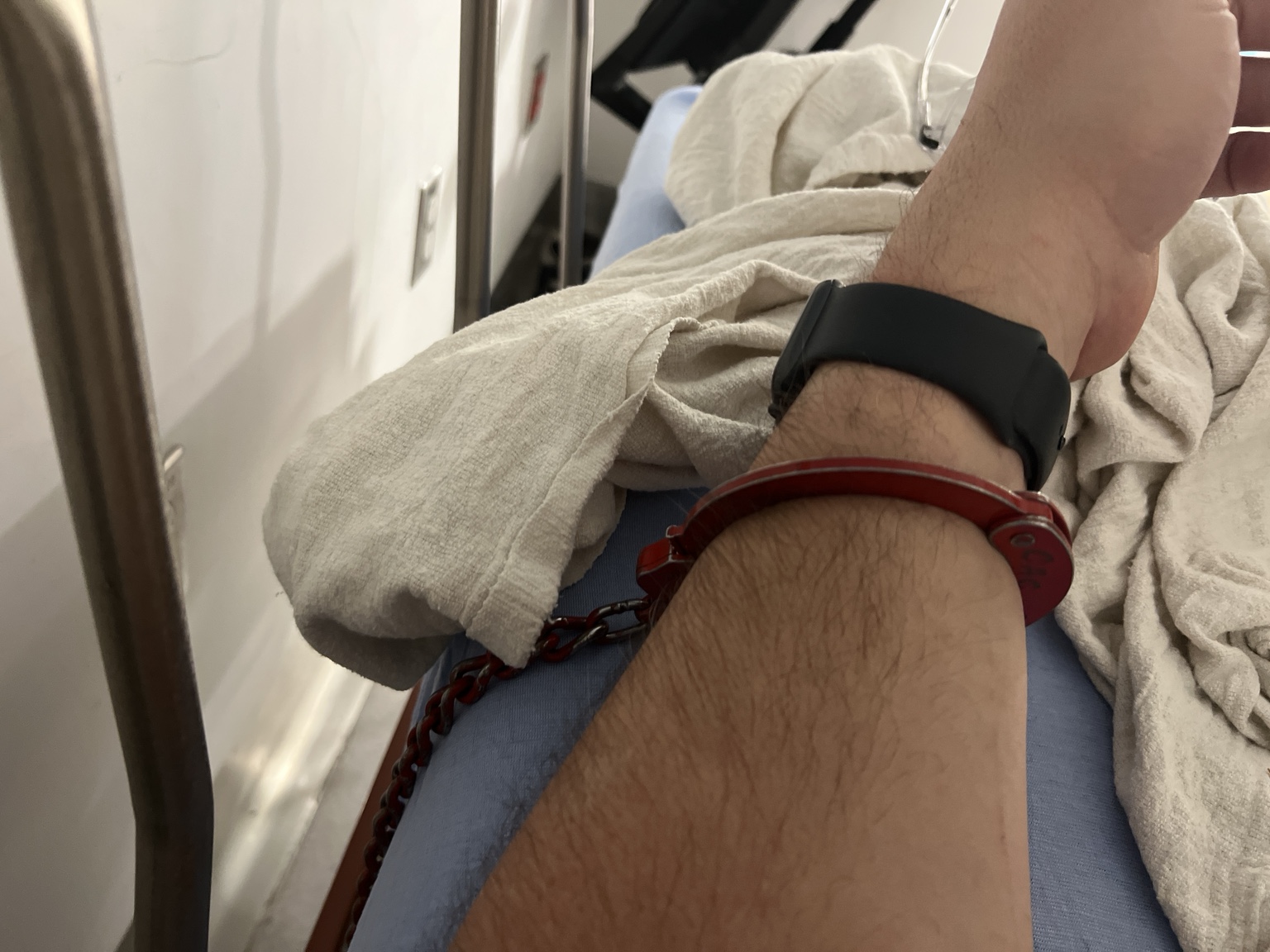
Boundary: identified court, hospital, lab, email, and source documents remain private. This image is presented as a de-identified visual anchor only.
FIRST AND FOREMOST
This is a medical journey with family in the boat.
The starting point is a real person living a medical and accessibility journey. Family is in the boat too. Project Fionigan is the navigation layer for that boat: it helps keep the medical journey, documents, questions, access needs, and next steps from scattering.
The website, overlay, pages, documents, and conference materials are context around that journey. The public version stays de-identified and informational.
How to use this page
Use Show controls for Help, Pages, Sections, Languages, Search, Play, and Voice. Major destinations open directly; full instructions are in Help.
Open Help for instructions. Open Languages for the language list.
De‑identified misdiagnosis case
This chapter of the Fionigan journey documents a critical escalation in the handling of a complex neurological condition at a regional hospital. The narrative below is distilled from first‑person accounts and contemporaneous medical notes. All materials on this page are based on the record reconstruction conducted in 2025–2026.
Plain-language access note: this public case study is written for access, human rights, de-identification, and continuity without exposing protected source details.
Background
Prior to 2025, the patient-author had lived with childhood neurologic history and chronic neck issues stemming from a 2022 prior cervical-spine surgery. In early 2025 he experienced a prolonged non‑epileptic seizure at home and sought care through the hospital’s emergency department a few days later. The seizure, combined with post‑ictal confusion, left him unable to speak clearly or operate a phone—a symptom consistent with Functional Neurological Disorder (FND)【144†L1-L7】. He requested neurological evaluation and asked specifically for his primary care provider, but the case was rapidly reframed as a psychiatric emergency.
Emergency Department and Admission
On arrival to the hospital’s emergency department on 17 February 2025, the patient-author communicated his FND diagnosis to the attending physician. The doctor admitted unfamiliarity with the condition and declined to consult neurology, instead initiating a psychiatric evaluation. This departure from his stated needs prompted the patient-author to create a speech‑to‑text directive on his phone and show it to the head nurse. The note explained that his impairments were neurological, not psychological【144†L1-L7】. A remote video-call witness later confirmed seeing him explain his case to the head nurse, though the witness did not necessarily see the exact moment the phone note was shown. Related chat logs remain preserved in the private governed archive. Shortly thereafter, under a Temporary Detention Order (TDO), he was transferred to a behavioral health unit at the same facility, where he spent approximately prolongeds in physical restraints【144†L1-L7】.
Misdiagnosis and Institutional Response
Throughout the hospitalization the treatment team documented a variety of psychiatric diagnoses—including “cannabis‑induced psychotic disorder,” bipolar disorder and malingering—while dismissing the patient-author’s repeated descriptions of involuntary movements. Nurses and social workers often described his behaviour as disruptive or aggressive despite notes showing that he remained cooperative in group settings and demonstrated clear reasoning【144†L1-L7】. The final discharge summary on 7 March 2025 listed “psychotic disorder NOS” and “possible bipolar disorder” but simultaneously noted that his thought process was linear and logical【144†L1-L7】.
Aftermath and Record Reconstruction
Following discharge, the patient-author filed human‑rights and FOIA complaints to obtain the records necessary to clarify what had happened. Over the course of 2025–2026 he collected and organised emergency records, psychiatry notes, group session logs, audiotapes and correspondence to build a complete timeline of these events. This research revealed numerous inconsistencies and highlighted the need for patient‑controlled record systems such as the Project Fionigan continuity architecture【144†L1-L7】.
Advocacy & Credentials
Beyond documenting his experience, the patient-author advocates for disability rights, all-inclusive accessibility and ethical AI. He holds certifications as a Certified Disability Rights & Accessibility Consultant through the U.S. Institute of Diplomacy and Human Rights, and he applies that work inside Project Fionigan’s all-inclusive accessibility-first continuity program. He has completed formal training in the use of ChatGPT and related AI tools.
A related credential/source image is held privately and is not shown on the public de-identified site.
A related credential/source image is held privately and is not shown on the public de-identified site.
A related credential/source image is held privately and is not shown on the public de-identified site.
Supporting Documents
The underlying documents for this case study are available as redacted public records. Each record has been carefully reviewed to remove personal identifiers while preserving context.
Access note: Identified source records are not published. Public evidence is limited to de-identified source-map entries and approved public images.